Showing posts with label Speech development. Show all posts

Sunday, September 15, 2013

Myths of Bilingualism and Speech Delays

Living in Miami we get asked all of the time if language delays are caused by learning more than one language. Given that this is a big misconception we thought it would be a good idea to get all of the myths of bilingualism debunked. So we interviewed an expert in this subject, speech-language pathologist Jennifer Rodriguez, M.A., CCC-SLP and she was nice enough to share her knowledge with us (you can read her bio at the end of this post). We compiled a list of most frequently asked questions and here is what she had to say...


Q: Will learning two languages cause speech or language impairments? 

A: No.  This is a big misconception and myth.  It is counterintuitive as one may think bombarding the system with two languages will cause a delay.  However, there is no research to support this.  There is no research that shows that hearing or learning more than one language will impair you or delay you.  If a child has a true language learning delay, this delay will manifest itself in both languages. Millions of people worldwide have learned multiple languages without acquiring a delay or language impairment.  Even children diagnosed with language impairment are capable of acquiring more than one language. Research has shown that bilinguals with diagnosed language impairment actually do better in the long run than their monolingual counterparts.
Bilingual children with language impairments showed commensurate language skills to monolinguals with language impairments (Paradis, 2005).
Bilingual children with language impairments exhibited same type and frequency of grammatical errors as monolinguals with language impairments (Paradis,Crago, Genesee, & Rice, 2003).
Bilingual children with Down Syndrome (DS) showed commensurate language skills to monolingual children with DS (Kay-Raining Bird, Cleave, Trudeau,Thordardottir, Sutton, & Thorpe, 2005).
  * 5 year study of bilinguals at Cornell Language AcquisitionLab revealed that learning a second language does not have any negative effect on child’s cognitive ability.

Q: Are there any benefits to being bilingual?

A: Many! It promotes mental agility and helps delay neurological disorders like dementia and Alzheimer Disease.Research has consistently shown that bilingual children typically have improved working memory (WM) and executive functioning abilities.  The enhanced ability to process sounds, another benefit of being bilingual, is a big advantage with regards to language acquisition. According to the American Psychiatric Association, bilinguals can actually pay attention better. This combined with the optimized brain capacity and increased concentration through the neuroplastic workout really lends itself to learning better in general. In addition, bilinguals have more career opportunities than monolinguals.

Q: My child is speaking “Spanglish” or mixing both languages.I’m concerned that he may be getting confused? What do I do?
A: Let us first discuss what is “Spanglish” or better known as Code Switching.  “Code-switching is a verbal skill requiring a large degree of linguistic competence in more than one language, rather than a defect arising from insufficient knowledge of one or the other… Rather than presenting deviant behavior, [it] is actually a suggestive indicator of degree of bilingual competence.” (François Grosjean)  Why do we do this? Well there are various reasons why. Code-switchingis a sign of mastery of two linguistic systems, not a sign of language confusion. Children as young as 2 years old are able to code-switch in socially appropriate ways (Lanza, 1992). Sometimes the other language has a better word or phrase to express a particular idea.  Sometimes the words we code-switch are the only ones we have, or they are more readily available in the other language.  Occasionally, we code-switch as a communicative tool, including to exclude someone or to show expertise. Children are products of their environments.  If they are constantly hearing “Spanglish,” then they will pick it up.  It is, however, natural for them to mix them as they are acquiring both and make errors such as “the house red” instead of “the red house.” It is important to remember that in terms of raising bilingual children, the experts agree that while they’re learning both languages, it is better if they’re exposed to each of them in a monolingual setting. In other words, children learn by example, so the less mixing you do, the less mixing they’ll do—at least until they become proficient in both languages.


Q: My child has a language delay.  Should I use only one language when speaking to him?
A: Many people, even professionals, believe that reducing to one language in the home will improve your childs chance for success, however,  this may have a negative impact on the child. This may cause a social emotional impact for child and family as it will result in reduced capacity and quality of communication with the family.  For example, if a parent only speaks Spanish but the child is delayed  in school and a professional told the parents to only speak to the child in English, how would that parent be able to communicate with the child? Also, if the parent is not proficient in that language what type of example are they setting for that child? Communicating in the language they speak best offers rich language and grammatical models. Moreover, reducing to one language may negatively impact  the child, decreaseself-esteem, and decreasing identity with community and culture.

Q:5. Can I hire a speech therapist to teach English to my child?
A: No,  that is the role of an English teacher or ESOL teacher.  Alicensed Speech-Language Pathologist should only treat children with a diagnosed speech and language impairment in that specific language.  Let’s say I evaluate a child in both English and Spanish. Results from that evaluation revealed that the child tested within normal limits in Spanish and was delayed in English.  Would they have a true language delay requiring speech therapy? Absolutely not.  Remember this.  A true language delay will manifest itself in both languages.  That is why it is important to look at the bilingual child’s both languages to determine if there is true language impairment or if they “appear” to be delayed secondary to second language acquisition.

How to foster a bilingual Environment:
Key ingredients: input ,exposure  and consistency no osmosis here 
Unrealistic to expect your child to learn Spanish by watching countless hours of Dora The Explorer
Children will develop a language if they feel they need it
If you create the need for more than one language the children will become bilingual
Make it a natural and unremarkable part of life


References and more information/links:


Jennifer Rodriguez, M.A., CCC-SLP, has been a bilingual speech-language pathologist at Miami Children’s Hospital-main campus over the past 6 years. She received her Master’s degree in Speech-Language Pathology at Temple University and was dually enrolled in the Bilingual Emphasis Program. Moreover, she has been published in the American Journal of Speech Language Pathology and has been active in the bilingual community by providing in-services, attending bilingual symposium conferences, and demonstrating best practices in assessment and treatment of bilingual populations.


Thursday, May 2, 2013

When to Stop Using a Baby Bottle???

By Karina Gonzalez, MS CCC-SLP

Pin It!

One of my last blog posts was about the importance of eliminating a pacifier and the havoc they can wreak in your child’s mouth. Well, I’m here today to tell you about another culprit…the baby bottle! Bottles are great for infants, hey, it’s the main source of nutrition for newborns if they are not breast fed, but when should you wean them off? And what’s the big deal if you let your child drink from a bottle well into toddlerhood? I remember my Mom letting me drink chocolate milk from a bottle before bed at 5 years of age! And I remember loving it! But it turns out that was not such a good idea and I’m here to hopefully answer some of these questions and persuade you to help your child kick the bottle habit.


First off, why should you wean your baby from a bottle? Well, if you have not read my post about pacifiers please click here, in this post I talked about the different dental malocclusions that pacifiers as well as bottles create. These malocclusions not only distort the shape of your child’s teeth, but they will also lead to tongue protrusions which can interfere with spoon feedings and speech delays in the future. Another important reason is that prolonged use of bottles leads to tooth decay, especially if you are offering sugary or acidic drinks like juice or chocolate milk. Hence why I had so many dentist visits! Not fun, very painful and expensive! Lastly, your child will be missing out on the opportunity to become a proficient cup and straw drinker.

So on to the next question…when should you eliminate the bottle?

Depending on who you ask, you will get different answers, but ideally bottle drinking should be discontinued by 12 months of age.

So how do you achieve this? Well, here’s my suggestion:

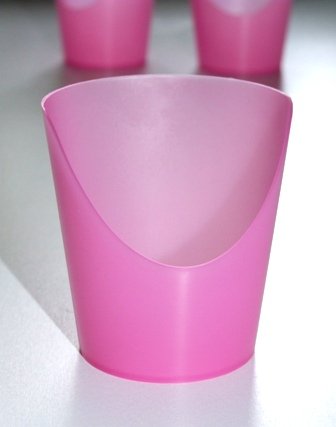
Begin to introduce open cup drinking around 6-7 months of age. Provided that your baby has good head control and can sit independently. Offer small, slow, controlled sips. Your child will have poor control and most of it will spill out, but with consistent practice, he will become better at it. A great training cup for your child is a nosey or flexi cup. They have a cut out so that you are able to tilt the cup higher without hitting your child’s nose. These are a staple in a feeding therapist bag of tricks. You can find them, HERE.
Picture credit: amazon.com
Practice cup drinking in the tub, this is a great way to not worry about the mess! Cup drinking also helps to develop hand coordination and encourages the transition to solid food.

Around the same time, begin to replace the bottle with a sippy cup, although not a better solution, I like sippy cups because they come with spill proof options, making it more realistic that cup or straw drinking when you are on the go. Remember, as soon as your child is able to hold and drink from a cup or straw, spouted sippy cups should be discontinued. If your child is having a hard time transitioning to a sippy cup, I recommend the Nuby Super Spout Easy Gripper. These cups have a soft silicone spout that makes the transition from bottle easier as it resembles the nipples from a bottle. The spout is also designed to put little pressure on the gums and teeth. These cups have an easy grip which encourages hand to mouth coordination.  The “TOUCH-FLO” feature releases the fluid with the pressure of your child’s sucking action, when your child stops sucking, the spout closes, eliminating leaks. This “valveless”, design makes it easier to clean.  These Nuby cups are also very affordable, as it is one of the company’s missions to provide affordable quality products that are designed with child’s development in mind. You can purchase Nuby sippy cup, HERE.
A better solution is a straw drinking. Any speech-language pathologist can tell you how great drinking for a straw is for your child’s oral motor and feeding skills. Straw drinking can be taught as early at 9 months, I have seen babies learn before and some after, but a child should learn it on their own by 2 years of age. Don’t worry if your child can’t get the hang of it at first. It may take a while but with practice he will begin to understand the concept. Contact us if you need help with teaching your child to drink from a straw. Once your child can drink from a straw you can purchase cups that have straws that flip closed and not worry about spillage, like this great Munchkin cup, HERE. Take a look at these fun straws, HERE.

Here are some other tips on bottle weaning…

·         Start early, the longer you wait the harder it will become. The older the child the harder the fight.

·         Don’t always offer juice or water in a cup and the milk in a bottle, this will lead to your child refusing to drink milk from a cup.

·         Be patient! Cup and straw drinking is a learned skill, your child will need lots of practice. Be prepared to get messy.

·         If your child is old enough, let him help you select the cup, he will be more likely to use it.

·         Offer your child the cup first and give the bottle only if he rejects it.

·         Try to avoid getting your child used to falling asleep with a bottle, this will create a dependency to be soothed by the bottle and getting rid of it at this time will be a struggle. Instead offer the last milk of the day via a cup 30 minutes before bed time and offer other soothing sleep time routines like reading a book.

·         Do not let your child crawl, walk or play with a bottle, this may create an attachment to it.

·         Try different cups or sippy cups, some have straws, some handles other don’t, the options are unlimited. You will soon discover which one works for your child.

Good luck! And I hope the transition is an easy one. Remember to be patient and offer your child lots of cuddling and encouragement during the process. His teeth and mouth will thank you in the long run.

As always we are here to help, please contact us at speakeatplay@gmail.com
How did you get your child to stop using a bottle? Please comment below we love to have more ideas.
Pin It!

Sunday, April 7, 2013

Increasing Your Child's Vocabulary

Other Words your Toddler Needs To know…

 
By Karina Gonzalez, MS CCC-SLP
 

Do you know what words your child needs to have in his/her vocabulary? What I have discovered throughout the years as a speech-language pathologist is that parents are great at teaching children the names of objects. I see many toddlers that know the names of many animals, toys, body parts and even modes of transportation. This is great! However, these kids have a difficult time speaking in phrases. I find that they generally use 1 word to communicate and seem to resort towards gestures for everything else they need to say. In order for your child to combine words into phrases he needs to know many other words, not just nouns. So if you are currently working on increasing your child’s vocabulary be sure to include the following words in his/her repertoire.  
 

Spatial Terms:

  • Up/down
  • In/on
  • Over/under
  • Next to or beside
  • On/off
  • Between


Sunday, February 17, 2013

Pacifier Use and Speech Development


What you may not know about a pacifier
by Karina Gonzalez, MS CCC-SLP
What is my biggest pet peeve? Seeing a toddler with a pacifier! There have even been times that I have seen 4 year olds with a paci in their mouths. Parents if this is your child, please don’t be offended, instead keep reading, I’m here to help. I’m sure every speech-language pathologist feels the same about the dreaded binky, tete, boopy, chupi, mimi, paci, sucky, etc. This innocent looking device is a speech development’s worst nightmare. Well I might be exaggerating a little, but I’m trying to prove a point. Don’t get me wrong, a pacifier serves a purpose in an infant’s life. It helps with soothing, calming and comforting babies, as well as quenching the instinctive desire to suck. This is a behavior that develops in utero, prenatal imaging has shown babies sucking their thumb or fingers before birth, so it’s only natural for your baby to want to suck. Another advantage of a pacifier is that it helps promote the sucking reflex in premature infants. Pacifiers have also been linked reducing the risk of sudden infant death syndrome (SIDS).

However, these benefits apply only to early infancy, as your baby grows the benefits decrease and they begin to wreak havoc in your baby’s mouth including…

Friday, February 1, 2013

Speech-Language Milestones


Do You Know Speech Development?

by Karina Gonzalez, MS CCC-SLP

When many parents think of speech and language development,the first thing that comes to mind is talking. They know there’s a problem whenthe child reaches a certain age and is not talking! But speech and languagedevelopment begins very early on and involves more than just words.  So as part of my ultimate mission to makeeveryone speech and language savvy, I have outlined the major stages oflanguage development for you to review, as well as activities that promotelanguage development, from birth to 3 years of age.

Birth to 3 months:

At this tender age, your child’s only needs are eating(lots of eating!), pooping (lots of pooping!) and sleeping (lots of sleeping!).At this stage your child is learning to adapt to the environment. There arelots of new sounds, visual stimuli, lots of touch (like wiping their bottomswith a cold wipie!), and movement, that will all help in the developmentof language.
 Here is what you willsee in speech-language development.


Auditory comprehension
Expressive language
Activities to promote development
Startles to loud sounds
Cries differently for different needs.
Make lots of eye contact.
Quiets when spoken to
Smiles when he sees you or during play
Talk to your baby when awake, during diaper changes, feeding, bath, etc.
Seems interested in your voice
Makes a pleasure sound called cooing, “coooh, goooh”
Play with sounds (such as oooh, aaah, mamama, bababa).

3 months to 6 months:
Wow! Your baby is a whole new person already! Stayingawake longer and is beginning to interact with you more. May also beinterested in toys, specially in his mouth! That’s right! your child wants toput everything in his mouth, blankets, toys, car keys, the dog’s tail! It can be anightmare! But mouthing is a very important part of speech  and feeding development and the topic of myfuture blog, so I will not go into detail now, but just remember they needit, this is their way of learning about their environment and the structures ofthe mouth. Just be careful and keep an watchful eye for small parts, sharpobjects, etc.

Auditory comprehension
Expressive language
Activities to promote development
Turns head towards direction of sound.
Babbling! Vocal productions sound more speech like...with sounds such as “bababa”, “mamama”
Respond to your child’s sounds and babbling. You can simply imitate what he is doing.
Notices a toy with sound
Chuckles and laughs! Makes gurgling sounds and other sound play with his mouth and throat.
Continue to talk to your baby through the day. Talk slow, clearly and in short phrases.
Pays attention to music
Mouthing of objects
Allow your baby to mouth safe objects, such as teething rings, his bib or blanket, toys, his hand etc.

6 months to 8 months:
 
Can you believe your baby is doing so much already? And wehaven’t gotten to the first birthday yet! Here’s what you should see at thisstage of development.


Auditory comprehension
Expressive language
Activities to promote development
Turns head to the direction of sounds.
Makes lots of sounds.
Play simple games like “peak-a-boo” and “patty-cake”
Listens when spoken to.
Uses gestures to communicate such as pointing, and waving bye.
Read colorful books with few words.
Starts to recognize some words like “bottle”, “ball”, “mama”, “daddy”.
Starting to use more syllables, “ba”, “da”, “ga”.
Play music and sing songs with lots of repetitive verses and rhyme, like “old McDonald”, “twinkle little star”, “itsy bitsy spider”.
Begins to respond to name.
Tries to imitate your speech sounds.
Take your child to new places and situations .

8 months-12 months:

This stage completes the first year of your baby’s life andit’s my favorite because this is when you  should  hear the  first word! Hopefully it will be “mama” so shecan be proud, but it’s okay if it’s not, as you will be happy regardless of theword.


Auditory comprehension
Expressive language
Activities to promote development
Begins to respond to simple request, like “come”, “up”, “want more”.
Says first words.
Teach your child the names of everyday items by repeating the names through out the day and in different phrases.
Fully recognizes name.
Will shout to get your attention.
Continue to talk slow, clearly and with short phrases.
Can now identify more objects and look in the direction of the object when named.
Imitates familiar words.
Continue with music, singing, and books.

12 months-17 months:

 
Happy Birthday to your baby, who is now on the way totoddler years and already the communication skills have grown so much! Now yourbaby can...

Auditory comprehension
Expressive language
Activities to promote development
Points to pictures, objects and family members.
Says 2-5 words including “mama” and “dada”
Continue to encourage words such as “mama”, “night-night”, “bye”, “more”. But do not pressure your baby to perform for you.
Understands simple instructions. Gives a toy or object upon request.
Enjoys making the sounds of animals and things.
Encourage imitation games and songs with gestures like “peak-a-boo” and “head shoulders knees and toes”. Continue reading books and using nursery rhymes.
Understands “no” and stops, at least momentarily.
Laughs often!
Continue to use short phrases when speaking to your child. Try to use only 2 words such as “bye dog” “more juice?” Be a good listener! And respond to the words your child says.

17 months -23 months:
 
Did you know that by the time your child turns 2, he will understand over 300 words? and here’s what else...


Auditory comprehension
Expressive language
Activities to promote development
Hears well and can discriminate sounds.
Uses 10-20 words, with new words every week and will reach past 50 words by 24 moths.
Read books frequently.
Can point to his nose, toes, and eyes.
Begins to combine 2 word phrases like “all gone” “bye mama”.
Talk simply, slowly and clearly to your child.
Brings you a familiar objects from another room when asked.
Points and gestures to show you a want or an event.
Perform activities that promote language development such as going for a walk, go to the park, go shopping, cook together.
Recognizes pictures of family members or familiar objects.
Hums and may try to sing a simple song.
Look at your child when he talks to you.

2-3 years old:


Your child is no longer a baby and can now communicate withlittle effort. Vocabulary has grown tremendously and is now talking in shortphrases. Language will continue to grow a great deal in thisyear of life, including:

Auditory comprehension
Expressive language
Activities to promote development
Identifies body parts.
Has “conversations”  with dolls or toys.
Be a good speech model. No “baby” talk.
Uses finger to tell you age.
Uses “no” in a phrase, like “no more”.
Play a game in which you give your child directions to practice listening skills, such as “touch your head”, “pick up the ball”.
Knows some spatial concepts like “on”, “up”, “in”.
Says his first name.
Avoid asking questions, and instead talk about what your child is doing
Knows words that describe things such as “big”, “little”.
Has a vocabulary of 300+ words and speaks in phrases of 2-3 words.
You can now read books with more words and words with rhyme.
Knows pronouns such as: “you”, “me”.
Asks to have needs met and will speak in phrases “I want more”.
Promote the learning of other words besides the name of objects, such as spatial terms (up, down, in, out), descriptive terms (big, dirty, happy), and pronouns (you, me, she).

So you reviewed the information and you realize your childmight not be doing some of the milestones on his age bracket. Don’t panic!Every child develops at different paces, as long as your child is doing most ofthem, he should continue to learn with your help. However, if your child is notdoing most of the milestones, then you should first speak to your pediatrician,and suggest a speech and language evaluation. 

I hope I have given you enough information that you canapply to your daily routines, as you can see there’s no set time of the day forspeech and language development, this is something that is done through out theday. Hopefully the activities I have provided can be easily applied to youreveryday routines.

Be sure to read all of our posts for more helpful information, and sign up to receive future updates to our blog.

Remember, I am here to help. If you have concerns about yourchild’s language development you can contact me at speakeatplay@gmail.com


Pin It!