
by Karina Rodriguez-Tellaheche, MS CCC-SLP
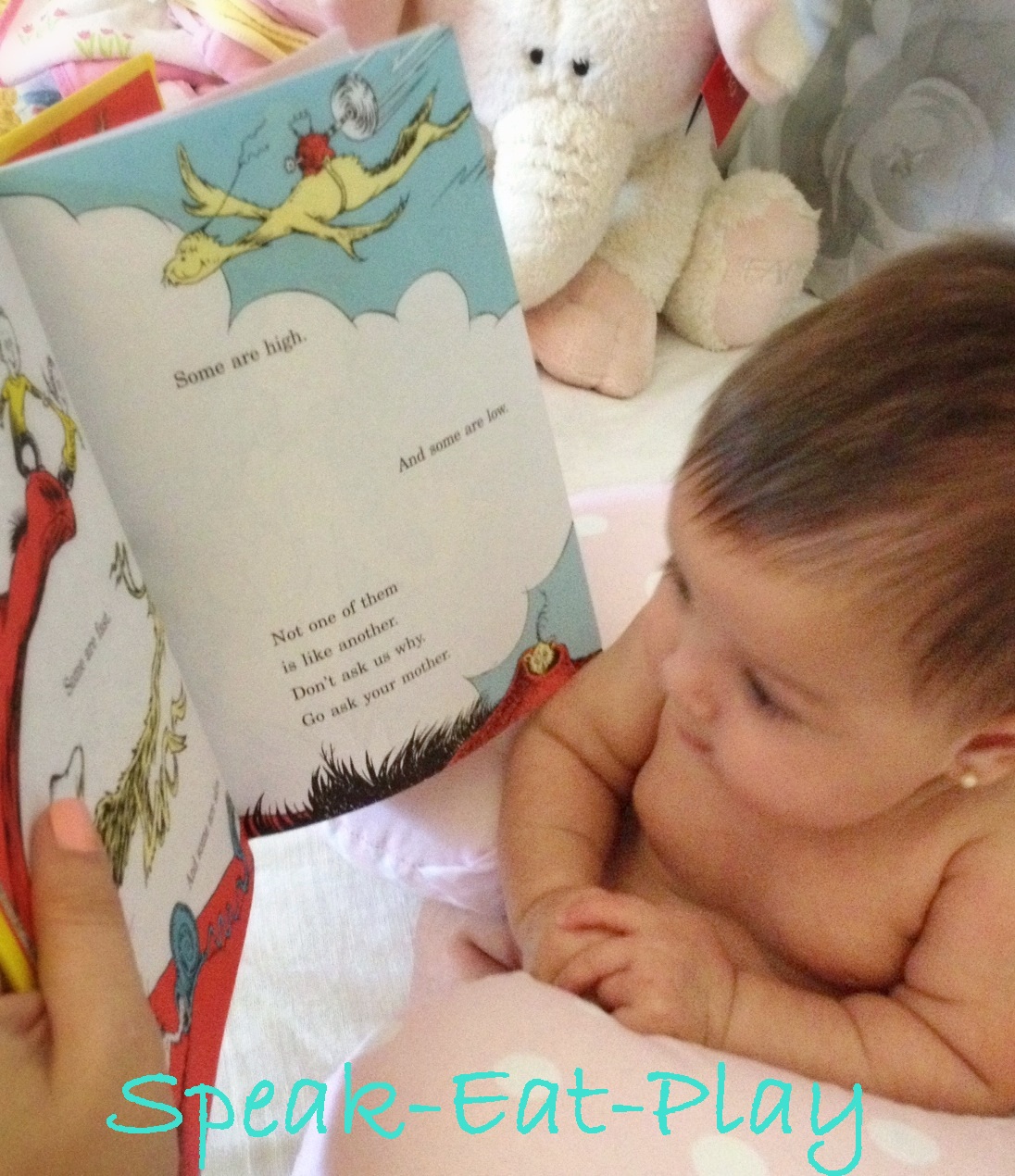
First read the book slowly and with lots of emphasis on words, sounds and emotion. Also exaggerate your facial expressions and add hand movements. Using my hands to gesture along with the book, motivates the child to do the same. Be sure to use the same movements, sound and facial expressions every time. After reading the book, the first few times, you may not get much participation, but slowly your child will begin to join in by imitating your hand movements, your facial expressions and slowly your words. I also pause before some key words and allow the child a chance to fill in the blank. After a few tries, they will! Be as fun and silly while reading, this will motivate your child to sit and look at the book with you. So until your child becomes an avid reader, you will need to provide the motivation.
Here is my list of top 5 books for promoting speech development. These books are available on Amazon.com. If you click on the tittle it will direct you to the link.

 Peek-a-Who? by Nina Laden: (Buy Here) This is a great book for infants, young toddlers and any child that is not yet talking or using only a few words. It's very simple, it only has about 6 pages and only 3 words per page, so it's great for little ones with short attention spans.
  This book is also perfect for repetition and prediction because it uses the same phrase over and over. The last page is a lot of fun because it has a mirror that kids love to see themselves in. Remember to use gestures, for example, put your hand up and pretend to toot the horn of the train for "peek-a-choo".
 Brown Bear, Brown Bear, What Do You See? by Bill Martin, Jr. (Buy Here) This Book is a classic and one of my staple therapy materials. It is a great book for any age, but it is especially great for teaching little ones how to put 2 word sentences together, for example "brown bear" "black sheep", etc. It is also great for vocabulary development as it teaches animal names, colors, actions and pronouns. It is a great book for gestures as well, you can gesture "what do you see?" by pointing to your eyes, or point to yourself when you read "looking at me".
 Where's Baby's Belly Button? by Karen Katz (Buy Here).The flip pages in this book make it very fun and interactive for little ones. It's great for learning body parts and learning to ask questions. Kids love to look for the hidden objects and get very exited when they find them. This author has other editions "where's baby's Mommy?" and "Ears, nose and toes?" you can purchase the bundle of all 3, HERE.

 Five Monkeys Jumping on the Bed by Eileen Christelow(Buy Here). I use this book with the bigger toddlers and preschoolers to teach them to put words into short phrases. It has a lot of repetition and it is great for teaching number knowledge and counting skills. I use finger puppets and we remove them as they start to "fall off the bed". You can find these adorable matching finger puppets, HERE.

 The Wheels on the Bus by Annie Kubler (Buy Here). This is a classic children's song used in preschools everywhere. So I tend to sing it when I read it. The reason I love this book is because of all the hand gestures and movements. So I use it with non-verbal kids who are not saying much to focus on imitation skills. Once they get very good at imitating my hand movements they usually begin to imitate the words as well. I also like the book because it has a lot of non-verbal sounds, like 'swish swish" (wipers) and "waa waa" (baby crying). Non-verbal words are typically learned before real words because they are easier and more motivating to say. So if your child is not saying many words, be sure to practice these and other non-verbal words and sounds over and over again.
 I hope you find this list of top books for speech delays useful and that you are able to use it with your child daily. Please be sure to comment if you have any questions or need further clarification on how to use these books.
Be sure to read my other posts on speech development :
Top 10 Apps for Speech and Fine Motor Development
Increasing Your Child's Vocabulary
Be sure to follow us by email to get updates on giveaways and future posts.
Don't forget to leaver your comments or questions below.
Thanks For Reading!

