Showing posts with label development. Show all posts

Tuesday, July 29, 2014

Top 5 Books for Speech Delays

How to Use Books for Speech Development.

by Karina Rodriguez-Tellaheche, MS CCC-SLP
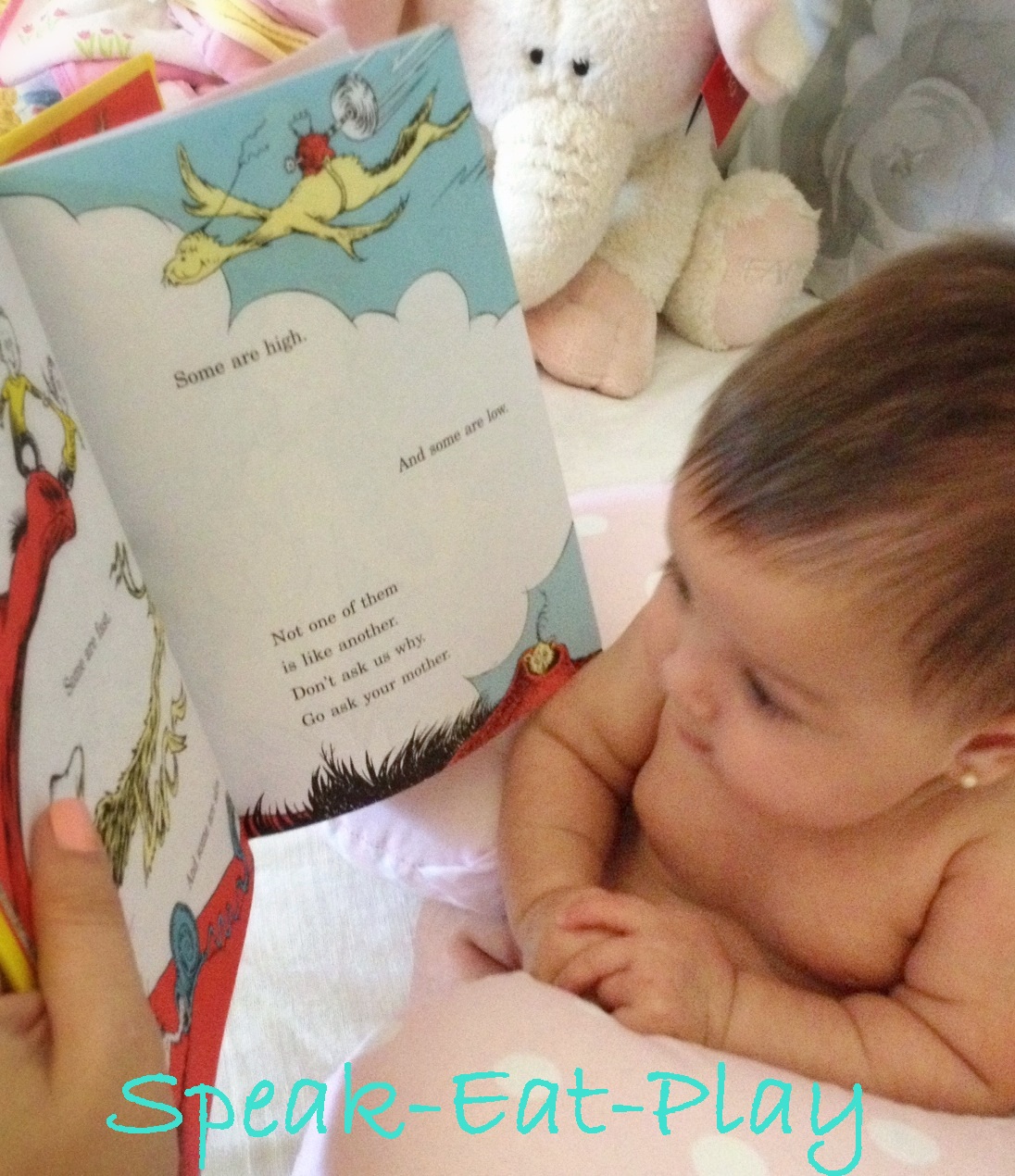
 
 I love to use books in my therapy sessions.  Books are great for many things, including literacy development, increasing joint attention, building social skills and speech development. Using a book to improve your child's speech and language skills is fairly simple, as you will see in my examples below. But first, there are some requirements. Your child will need to stay focused on the book, make sure there are no other distractions. Turn the TV off and hide the more motivating toys. Keep in mind that the younger your child is, the shorter the attention span. Toddlers can only maintain attention for a few minutes, so you will have to choose books that only have a few pages and with bright colors. When choosing books for children with speech delays, it is important to look for books that have repetition, this is one of the techniques speech language pathologists use in therapy. This is because children with delays need to hear a word or phrase multiple times in order to learn it. Repetition also adds predictability, you will notice that after reading the same book several times your child will start to learn the word and fill in the blanks.  If your child has been diagnosed with Apraxia, using books with repetition is a very effective technique. Below are other techniques that can help children diagnosed with Apraxia. 

First read the book slowly and with lots of emphasis on words, sounds and emotion. Also exaggerate your facial expressions and add hand movements. Using my hands to gesture along with the book, motivates the child to do the same. Be sure to use the same movements, sound and facial expressions every time. After reading the book, the first few times, you may not get much participation, but slowly your child will begin to join in by imitating your hand movements, your facial expressions and slowly your words. I also pause before some key words and allow the child a chance to fill in the blank. After a few tries, they will!  Be as fun and silly while reading, this will motivate your child to sit and look at the book with you. So until your child becomes an avid reader, you will need to provide the motivation. 

Here is my list of top 5 books for promoting speech development.  These books are available on Amazon.com. If you click on the tittle it will direct you to the link.


Peek-a-Who? by Nina Laden: (Buy Here) This is a great book for infants, young toddlers and any child that is not yet talking or using only a few words. It's very simple, it only has about 6 pages and only 3 words per page, so it's great for little ones with short attention spans. This book is also perfect for repetition and prediction because it uses the same phrase over and over.  The last page is a lot of fun because it has a mirror that kids love to see themselves in. Remember to use gestures, for example, put your hand up and pretend to toot the horn of the train for "peek-a-choo".


Brown Bear, Brown Bear, What Do You See? by Bill Martin, Jr. (Buy Here) This Book is a classic and one of my staple therapy materials. It is a great book for any age, but it is especially great for teaching little ones how to put 2 word sentences together, for example "brown bear" "black sheep", etc. It is also great for vocabulary development as it teaches animal names, colors, actions and pronouns. It is a great book for gestures as well, you can gesture "what do you see?" by pointing to your eyes, or point to yourself when you read "looking at me".


 Where's Baby's Belly Button? by Karen Katz (Buy Here).The flip pages in this book make it very fun and interactive for little ones. It's great for learning body parts and learning to ask questions. Kids love to look for the hidden objects and get very exited when they find them. This author has other editions "where's baby's Mommy?" and "Ears, nose and toes?" you can purchase the bundle of all 3, HERE.


 Five Monkeys Jumping on the Bed by Eileen Christelow
(Buy Here). I use this book with the bigger toddlers and preschoolers to teach them to put words into short phrases. It has a lot of repetition and it is great for teaching number knowledge and counting skills. I use finger puppets and we remove them as they start to "fall off the bed". You can find these adorable matching finger puppets, HERE. 
 

 The Wheels on the Bus by Annie Kubler (Buy Here). This is a classic children's song used in preschools everywhere. So I tend to sing it when I read it. The reason I love this book is because of all the hand gestures and movements. So I use it with non-verbal kids who are not saying much to focus on imitation skills. Once they get very good at imitating my hand movements they usually begin to imitate the words as well. I also like the book because it has a lot of non-verbal sounds, like 'swish swish" (wipers) and "waa waa" (baby crying). Non-verbal words are typically learned before real words because they are easier and more motivating to say. So if your child is not saying many words, be sure to practice these and other non-verbal words and sounds over and over again. 

I hope you find this list of top books for speech delays useful and that you are able to use it with your child daily. Please be sure to comment if you have any questions or need further clarification on how to use these books.


Be sure to read my other posts on speech development :

Top 10 Apps for Speech and Fine Motor Development

Increasing Your Child's Vocabulary


Be sure to follow us by email to get updates on giveaways and future posts. 


Don't forget to leaver your comments or questions below.

Thanks For Reading!


Thursday, June 13, 2013

Budget Friendly Summer Fun!

Jackeline Gurdian, Occupational Therapist


It’s officially summer! Your kids have been waiting for this day since last August, but if your summer entertainment budget is a little low, we can help! Keep reading for fun and affordable activities that have been kid and therapist tested and approved (and you might have some fun too!). Don’t forget you can always tweak these to fit your kid’s age and abilities. Be creative!


Go fishing!


It is really really hot outside so playing with water is a no brainer! Lately most big stores like Target, Walmart or Toys "R" Us have lots of affordable (even $1 section) water toys.
Ok so for fun fishing activity without worrying about the dangers of fishing with toddlers, first buy a plastic wading pool ($7 at Toys "R" Us), magnet letters or toys and you can find a magnet child’s fishing rod or even make one! Here is an easy tutorial to make your own game- Click here!
Some ways to change this game to challenge your child or be more interactive:


Saturday, May 18, 2013

Separation Anxiety


Separation Anxiety: When should you worry?

Jackeline Gurdian, MS, OTR/L

I’m pretty sure I’m not the only one who has suffered with this. I sometimes find myself apologizing for my daughter when she doesn’t want to be with anyone but mom or dad. (in my case mostly dad L). The more and more I talk about this with other parents, the more I realize that this is a problem that we are all dealing with.


So….Is it normal?

YES! Children often deal with separation by showing their true colors (crying, tantrums, etc.). This is a normal developmental stage in your child’s life. This anxiety will usually begin between 8-14 months; they often start to fear new people or new places. At this stage, children have a hard time understanding time and might feel like you will never come back. Usually around 2 years of age, most children outgrow this stage. Please note that it’s ok if at times your child demonstrates separation anxiety during periods of stress.

What can you do?


Wednesday, April 17, 2013

Social Skills


Does your child need help with social skills?

by Jackeline Gurdian, MS, OTR/L


It is key for a child to have positive relationships with peers to allow for maximal success in life. Academic skills are very important of course but without appropriate social skills, success is limited.

Social skills begin at birth but we often start to see and hear parents complain about delays when the child begins school.


Here are some examples of social skills that school aged children (4-5 years of age) should have:

·         Play group games appropriately (plays fair, takes turns, etc.)

·         Make close friends

·         Win or lose gracefully

·         Shows interest in others

·         Able to interact nonverbally (smiling, nodding, etc.)

·         Initiate and maintain conversations

·         Able to empathize with peers

·         Participate in pretend play

·         Able to stay on task for at least 5 minutes

·         Establish good eye contact with peers


Children learn from imitation and practice, so it is important to always show appropriate behaviors for your child to follow. For some children, social skills come naturally and others need a little help. If you feel your child needs a little or even a lot of help, please do not hesitate to contact us speakeatplay@gmail.com and we would be more than happy to find a social skills group that fits your child’s needs.
 
 
Please feel free to leave any comments below, we would love to hear your thoughts. Like our blog? be sure to sign up to recieve new posts via email or follow us on facebook facebook.com/speakeatplay.
Pin It!

Sunday, April 7, 2013

Increasing Your Child's Vocabulary

Other Words your Toddler Needs To know…

 
By Karina Gonzalez, MS CCC-SLP
 

Do you know what words your child needs to have in his/her vocabulary? What I have discovered throughout the years as a speech-language pathologist is that parents are great at teaching children the names of objects. I see many toddlers that know the names of many animals, toys, body parts and even modes of transportation. This is great! However, these kids have a difficult time speaking in phrases. I find that they generally use 1 word to communicate and seem to resort towards gestures for everything else they need to say. In order for your child to combine words into phrases he needs to know many other words, not just nouns. So if you are currently working on increasing your child’s vocabulary be sure to include the following words in his/her repertoire.  
 

Spatial Terms:

  • Up/down
  • In/on
  • Over/under
  • Next to or beside
  • On/off
  • Between


Friday, March 29, 2013

Positional Plagiocephaly


Does your baby have flat areas on his head (Positional Plagiocephaly)?

By Jackie Gurdian, MS, OTR/L

Childbirth is an adventurous ride for your baby and sometimes it results in your newborn looking like a cone head, but don’t worry, because your baby’s skull will even out on its own.


Some babies develop a flat area after birth, this is called positional plagiocephaly. Flatness can occur on either side of the back of the head.

Why does this occur?

One of the main reasons why babies develop flat areas is because they sleep or rest in same position repeatedly. It is not recommended that babies spend too much time laying on their backs when they are awake, or anywhere where their head is laying head against a surface.

Another reason is having weak neck muscles. Your baby could be having difficulty turning his head to both sides. This can lead to torticollis, other times the child has torticollis which leads to flatness (information on torticollis coming soon). 

Prematurity is also another reason that plagiocephaly can occur. Premature babies have softer skulls than most full term babies and possibly could be spending time in the neonatal intensive care unit (NICU) where they are unable to move from the same position for long periods of time.

Positional plagiocephaly can also occur in utero when there is pressure placed on your baby’s skull.


What do you do if you suspect your child may have positional plagiocephaly?

This could be very easy for you to notice. Most of the time you will see a flattened side and this may cause that side to look pushed towards the front of the face. You may also notice asymmetry when looking at the face in frontal view.

If you suspect your child may have a “flat head”, ask the doctor. The doctor could recommend simple positioning changes to make around the house or possibly a custom molded helmet to provide pressure on some areas and allow growth in others.

How can you prevent positional plagiocephaly?

·         Lots and lots of tummy time to not only prevent baby being on his back for so long but also to strengthen their neck muscles. You could also try baby carriers when you need to be on the go.

·         Try putting baby at different ends of the crib every nap or bedtime. Usually if you are right handed you will place child in crib the same way every time try and alternate what arm you use to hold baby.

·         Limit the time that the baby is in equipment such as car seat, bouncy chair, swing or other similar seats.

·         If you have crib safe toys, alternate sides in which baby will have to look to play.
  • Use a product like the Tortle, a beanie especially made for positional plagiocephaly, we wrote a review about it HERE.    

If you would like more information on different positional adjustments to make for your child please contact us speakeatplay@gmail.com.  We will also love to read your comments and any other suggestions you have tried.
Be sure to like our facebook page for updates and other informational posts www.facebook.com/speakeatplay

Thanks for reading!
Pin It!

Friday, February 15, 2013

Bilateral Coordination Skills

Doesyour child have poor bilateral coordination skills?

By Jackie Gurdian, MS OTR/L
 

A bilateral skill is the child’s ability to utilize bothsides of the body for activities. A child with poor bilateral skills wouldprefer to use one hand than use both hands together for activities that requiretwo hands. Some children with hemiparesis have significant weakness in one sideof the body. It’s important to incorporate affected side to increase functionaluse of hand.

Below you will find some fun activities to incorporate inthe home to promote bilateral skills. Remember to have fun!

Bilateral Activities


Everyday household activities
  • Carry container
  • Help clear table after lunch, dinner, etc.
  • Open packages (candy for increased motivation)
  • Push large object on floor such as laundry basket or garbage
  • Help with mixing food (ex: cake mix)
  • Twist to ring water out of towel
  • Hold cup


  • Spread butter/peanut butter on bread/crackers or frosting on cookies
  • Place empty containers inside each other (yogurt, butter)
  • Bath time: fill up containers with water and pour them out

School and fine motoractivities


  • Cut paper
  • Tear paper


  • Hold paper down with affected hand and draw/color with the unaffected hand

Sports

  • Play catch
  • Monkey bars
 
 
  • Jump rope
  • Swim
  • Hold on to swing with both hands


  • Hold baseball bat
  • Ride bicycle
 

    Games and toys

    • Blow bubbles and have child pop by clapping


    • Play finger games (Itsy Bitsy Spider)
    • Sew or string beads
    • Snap/Pop beads
    • Lego’s
    • Playing 2 handed musical instrument (drums, recorder, piano, guitar)
    • Push a cart (play stroller, shopping cart, lawn mower, etc.)
    • Play videogame with controller
    • Remote control car, plane or boat
    • Fly a kite
    • Create “jungle”- clear cushions off couch and chairs and have child crawl and climb through “jungle”
    • Make sand castles at the beach
    • Crawl through a maze
     
    • Scooter board game
     
    • Wheelbarrow walk
    • Play Simon Says
    If you have any questions, please don’t hesitate to contactme at speakeatplay@gmail.com. As always please consult your child’s physician before any activity.

    If you like our posts be sure to follow us.

    Source: Case-Smith, Jane. Occupational Therapy for Children,6th edition.
    Pin It!