Showing posts with label therapy. Show all posts

Tuesday, July 29, 2014

Top 5 Books for Speech Delays

How to Use Books for Speech Development.

by Karina Rodriguez-Tellaheche, MS CCC-SLP
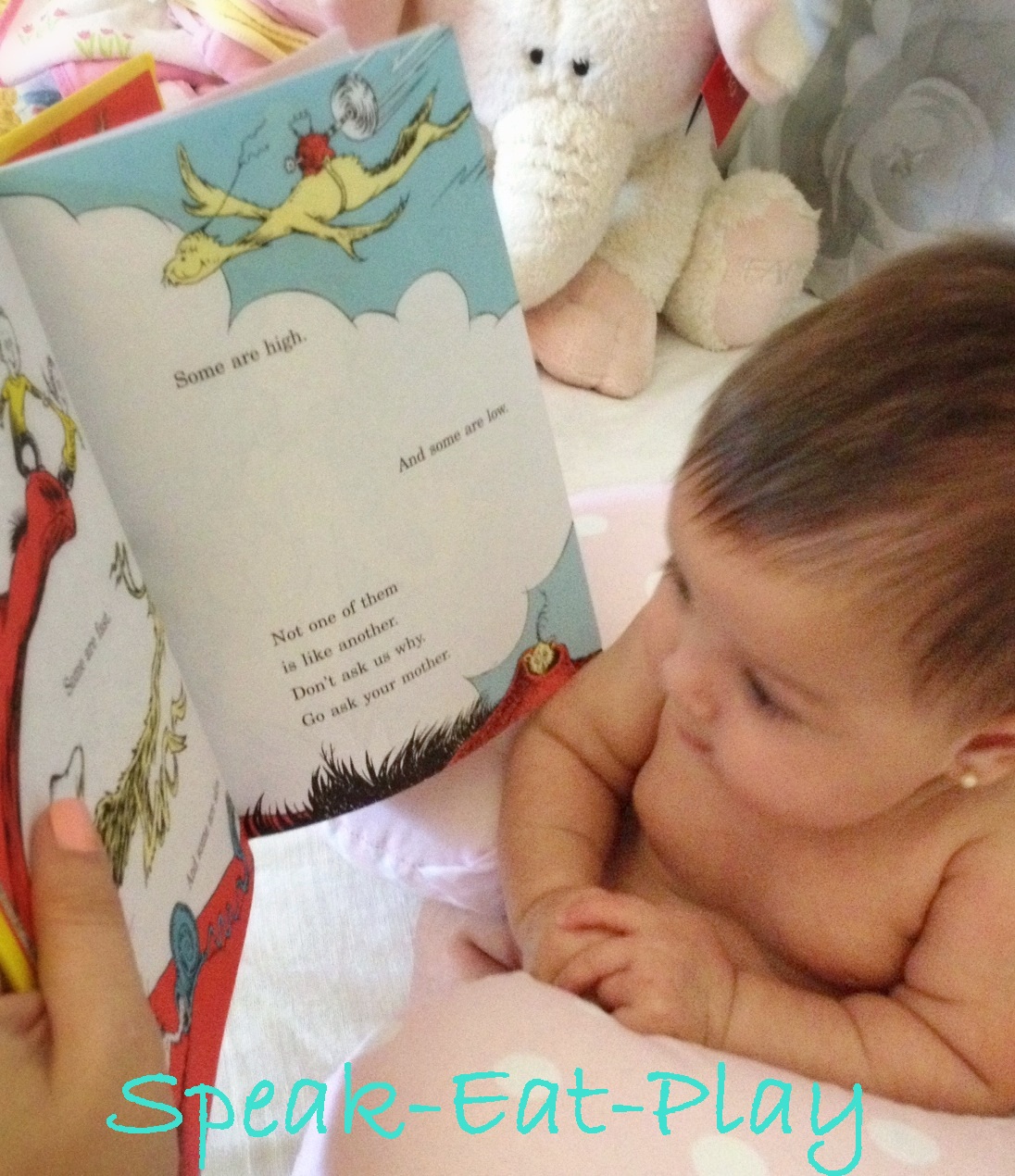
 
 I love to use books in my therapy sessions.  Books are great for many things, including literacy development, increasing joint attention, building social skills and speech development. Using a book to improve your child's speech and language skills is fairly simple, as you will see in my examples below. But first, there are some requirements. Your child will need to stay focused on the book, make sure there are no other distractions. Turn the TV off and hide the more motivating toys. Keep in mind that the younger your child is, the shorter the attention span. Toddlers can only maintain attention for a few minutes, so you will have to choose books that only have a few pages and with bright colors. When choosing books for children with speech delays, it is important to look for books that have repetition, this is one of the techniques speech language pathologists use in therapy. This is because children with delays need to hear a word or phrase multiple times in order to learn it. Repetition also adds predictability, you will notice that after reading the same book several times your child will start to learn the word and fill in the blanks.  If your child has been diagnosed with Apraxia, using books with repetition is a very effective technique. Below are other techniques that can help children diagnosed with Apraxia. 

First read the book slowly and with lots of emphasis on words, sounds and emotion. Also exaggerate your facial expressions and add hand movements. Using my hands to gesture along with the book, motivates the child to do the same. Be sure to use the same movements, sound and facial expressions every time. After reading the book, the first few times, you may not get much participation, but slowly your child will begin to join in by imitating your hand movements, your facial expressions and slowly your words. I also pause before some key words and allow the child a chance to fill in the blank. After a few tries, they will!  Be as fun and silly while reading, this will motivate your child to sit and look at the book with you. So until your child becomes an avid reader, you will need to provide the motivation. 

Here is my list of top 5 books for promoting speech development.  These books are available on Amazon.com. If you click on the tittle it will direct you to the link.


Peek-a-Who? by Nina Laden: (Buy Here) This is a great book for infants, young toddlers and any child that is not yet talking or using only a few words. It's very simple, it only has about 6 pages and only 3 words per page, so it's great for little ones with short attention spans. This book is also perfect for repetition and prediction because it uses the same phrase over and over.  The last page is a lot of fun because it has a mirror that kids love to see themselves in. Remember to use gestures, for example, put your hand up and pretend to toot the horn of the train for "peek-a-choo".


Brown Bear, Brown Bear, What Do You See? by Bill Martin, Jr. (Buy Here) This Book is a classic and one of my staple therapy materials. It is a great book for any age, but it is especially great for teaching little ones how to put 2 word sentences together, for example "brown bear" "black sheep", etc. It is also great for vocabulary development as it teaches animal names, colors, actions and pronouns. It is a great book for gestures as well, you can gesture "what do you see?" by pointing to your eyes, or point to yourself when you read "looking at me".


 Where's Baby's Belly Button? by Karen Katz (Buy Here).The flip pages in this book make it very fun and interactive for little ones. It's great for learning body parts and learning to ask questions. Kids love to look for the hidden objects and get very exited when they find them. This author has other editions "where's baby's Mommy?" and "Ears, nose and toes?" you can purchase the bundle of all 3, HERE.


 Five Monkeys Jumping on the Bed by Eileen Christelow
(Buy Here). I use this book with the bigger toddlers and preschoolers to teach them to put words into short phrases. It has a lot of repetition and it is great for teaching number knowledge and counting skills. I use finger puppets and we remove them as they start to "fall off the bed". You can find these adorable matching finger puppets, HERE. 
 

 The Wheels on the Bus by Annie Kubler (Buy Here). This is a classic children's song used in preschools everywhere. So I tend to sing it when I read it. The reason I love this book is because of all the hand gestures and movements. So I use it with non-verbal kids who are not saying much to focus on imitation skills. Once they get very good at imitating my hand movements they usually begin to imitate the words as well. I also like the book because it has a lot of non-verbal sounds, like 'swish swish" (wipers) and "waa waa" (baby crying). Non-verbal words are typically learned before real words because they are easier and more motivating to say. So if your child is not saying many words, be sure to practice these and other non-verbal words and sounds over and over again. 

I hope you find this list of top books for speech delays useful and that you are able to use it with your child daily. Please be sure to comment if you have any questions or need further clarification on how to use these books.


Be sure to read my other posts on speech development :

Top 10 Apps for Speech and Fine Motor Development

Increasing Your Child's Vocabulary


Be sure to follow us by email to get updates on giveaways and future posts. 


Don't forget to leaver your comments or questions below.

Thanks For Reading!


Sunday, September 15, 2013

Myths of Bilingualism and Speech Delays

Living in Miami we get asked all of the time if language delays are caused by learning more than one language. Given that this is a big misconception we thought it would be a good idea to get all of the myths of bilingualism debunked. So we interviewed an expert in this subject, speech-language pathologist Jennifer Rodriguez, M.A., CCC-SLP and she was nice enough to share her knowledge with us (you can read her bio at the end of this post). We compiled a list of most frequently asked questions and here is what she had to say...


Q: Will learning two languages cause speech or language impairments? 

A: No.  This is a big misconception and myth.  It is counterintuitive as one may think bombarding the system with two languages will cause a delay.  However, there is no research to support this.  There is no research that shows that hearing or learning more than one language will impair you or delay you.  If a child has a true language learning delay, this delay will manifest itself in both languages. Millions of people worldwide have learned multiple languages without acquiring a delay or language impairment.  Even children diagnosed with language impairment are capable of acquiring more than one language. Research has shown that bilinguals with diagnosed language impairment actually do better in the long run than their monolingual counterparts.
* Bilingual children with language impairments showed commensurate language skills to monolinguals with language impairments (Paradis, 2005).
* Bilingual children with language impairments exhibited same type and frequency of grammatical errors as monolinguals with language impairments (Paradis,Crago, Genesee, & Rice, 2003).
* Bilingual children with Down Syndrome (DS) showed commensurate language skills to monolingual children with DS (Kay-Raining Bird, Cleave, Trudeau,Thordardottir, Sutton, & Thorpe, 2005).
  * 5 year study of bilinguals at Cornell Language AcquisitionLab revealed that learning a second language does not have any negative effect on a child’s cognitive ability.

Q: Are there any benefits to being bilingual?

A: Many! It promotes mental agility and helps delay neurological disorders like dementia and Alzheimer Disease.Research has consistently shown that bilingual children typically have improved working memory (WM) and executive functioning abilities.  The enhanced ability to process sounds, another benefit of being bilingual, is a big advantage with regards to language acquisition. According to the American Psychiatric Association, bilinguals can actually pay attention better. This combined with the optimized brain capacity and increased concentration through the neuroplastic workout really lends itself to learning better in general. In addition, bilinguals have more career opportunities than monolinguals.

Q: My child is speaking “Spanglish” or mixing both languages.I’m concerned that he may be getting confused? What do I do?
A: Let us first discuss what is “Spanglish” or better known as Code Switching.  “Code-switching is a verbal skill requiring a large degree of linguistic competence in more than one language, rather than a defect arising from insufficient knowledge of one or the other… Rather than presenting deviant behavior, [it] is actually a suggestive indicator of degree of bilingual competence.” (François Grosjean)  Why do we do this? Well there are various reasons why. Code-switching, is a sign of mastery of two linguistic systems, not a sign of language confusion. Children as young as 2 years old are able to code-switch in socially appropriate ways (Lanza, 1992). Sometimes the other language has a better word or phrase to express a particular idea.  Sometimes the words we code-switch are the only ones we have, or they are more readily available in the other language.  Occasionally, we code-switch as a communicative tool, including to exclude someone or to show expertise. Children are products of their environments.  If they are constantly hearing “Spanglish,” then they will pick it up.  It is, however, natural for them to mix them as they are acquiring both and make errors such as “the house red” instead of “the red house.” It is important to remember that in terms of raising bilingual children, the experts agree that while they’re learning both languages, it is better if they’re exposed to each of them in a monolingual setting. In other words, children learn by example, so the less mixing you do, the less mixing they’ll do—at least until they become proficient in both languages.


Q: My child has a language delay.  Should I use only one language when speaking to him?
A: Many people, even professionals, believe that reducing to one language in the home will improve your child’s chance for success, however,  this may have a negative impact on the child. This may cause a social emotional impact for child and family as it will result in reduced capacity and quality of communication with the family.  For example, if a parent only speaks Spanish but the child is delayed  in school and a professional told the parents to only speak to the child in English, how would that parent be able to communicate with the child? Also, if the parent is not proficient in that language what type of example are they setting for that child? Communicating in the language they speak best offers rich language and grammatical models. Moreover, reducing to one language may negatively impact  the child, decreaseself-esteem, and decreasing identity with community and culture.

Q:5. Can I hire a speech therapist to teach English to my child?
A: No,  that is the role of an English teacher or ESOL teacher.  Alicensed Speech-Language Pathologist should only treat children with a diagnosed speech and language impairment in that specific language.  Let’s say I evaluate a child in both English and Spanish. Results from that evaluation revealed that the child tested within normal limits in Spanish and was delayed in English.  Would they have a true language delay requiring speech therapy? Absolutely not.  Remember this.  A true language delay will manifest itself in both languages.  That is why it is important to look at the bilingual child’s both languages to determine if there is true language impairment or if they “appear” to be delayed secondary to second language acquisition.

How to foster a bilingual Environment:
* Key ingredients: input ,exposure  and consistency no osmosis here 
* Unrealistic to expect your child to learn Spanish by watching countless hours of “Dora The Explorer”
* Children will develop a language if they feel they need it
* If you create the need for more than one language the children will become bilingual
* Make it a natural and unremarkable part of life


References and more information/links:


Jennifer Rodriguez, M.A., CCC-SLP, has been a bilingual speech-language pathologist at Miami Children’s Hospital-main campus over the past 6 years. She received her Master’s degree in Speech-Language Pathology at Temple University and was dually enrolled in the Bilingual Emphasis Program. Moreover, she has been published in the American Journal of Speech Language Pathology and has been active in the bilingual community by providing in-services, attending bilingual symposium conferences, and demonstrating best practices in assessment and treatment of bilingual populations.


Friday, May 24, 2013

Food Play for Problem Feeders

Play with your food!

Karina Gonzalez, M.S., CCC-SLP

Do you remember your parents telling you to not play with your food? Well, I'm here to tell you that for a picky eater or a child that is aversive to textures, playing with food is a must. All children need to explore textures with their hands. Exploring the textures of food, helps to develop a good eating habit. It is important to start early, yes as soon as he's old enough to sit on a high chair, and don't be afraid to get messy! Playing with food has many benefits, here are a few:
  • Allows the child to become comfortable with the colors, textures, and smells of food with out having to eat it.
  • Makes meal time fun.
  • Helps get rid of any sensory issues on the hands and fingers (Some of these kids don't like to touch sand, grass, or even soap).
  • Builds confidence, especially if you reward them.
  • Develops good eating habits (as mentioned above).
  • Develops good hand-eye coordination.
  • Develops find motor skills, especially if they have to pick up small foods like Cheerios or slippery ones like spaghetti.
  • Develops hand to mouth coordination that will also help with overall self feeding skills.
  • Helps to develop play skills. 

Saturday, May 18, 2013

Separation Anxiety


Separation Anxiety: When should you worry?

Jackeline Gurdian, MS, OTR/L

I’m pretty sure I’m not the only one who has suffered with this. I sometimes find myself apologizing for my daughter when she doesn’t want to be with anyone but mom or dad. (in my case mostly dad L). The more and more I talk about this with other parents, the more I realize that this is a problem that we are all dealing with.


So….Is it normal?

YES! Children often deal with separation by showing their true colors (crying, tantrums, etc.). This is a normal developmental stage in your child’s life. This anxiety will usually begin between 8-14 months; they often start to fear new people or new places. At this stage, children have a hard time understanding time and might feel like you will never come back. Usually around 2 years of age, most children outgrow this stage. Please note that it’s ok if at times your child demonstrates separation anxiety during periods of stress.

What can you do?


Friday, February 15, 2013

Bilateral Coordination Skills

Doesyour child have poor bilateral coordination skills?

By Jackie Gurdian, MS OTR/L
 

A bilateral skill is the child’s ability to utilize bothsides of the body for activities. A child with poor bilateral skills wouldprefer to use one hand than use both hands together for activities that requiretwo hands. Some children with hemiparesis have significant weakness in one sideof the body. It’s important to incorporate affected side to increase functionaluse of hand.

Below you will find some fun activities to incorporate inthe home to promote bilateral skills. Remember to have fun!

Bilateral Activities


Everyday household activities
  • Carry container
  • Help clear table after lunch, dinner, etc.
  • Open packages (candy for increased motivation)
  • Push large object on floor such as laundry basket or garbage
  • Help with mixing food (ex: cake mix)
  • Twist to ring water out of towel
  • Hold cup


  • Spread butter/peanut butter on bread/crackers or frosting on cookies
  • Place empty containers inside each other (yogurt, butter)
  • Bath time: fill up containers with water and pour them out

School and fine motoractivities


  • Cut paper
  • Tear paper


  • Hold paper down with affected hand and draw/color with the unaffected hand

Sports

  • Play catch
  • Monkey bars
 
 
  • Jump rope
  • Swim
  • Hold on to swing with both hands


  • Hold baseball bat
  • Ride bicycle
 

    Games and toys

    • Blow bubbles and have child pop by clapping


    • Play finger games (Itsy Bitsy Spider)
    • Sew or string beads
    • Snap/Pop beads
    • Lego’s
    • Playing 2 handed musical instrument (drums, recorder, piano, guitar)
    • Push a cart (play stroller, shopping cart, lawn mower, etc.)
    • Play videogame with controller
    • Remote control car, plane or boat
    • Fly a kite
    • Create “jungle”- clear cushions off couch and chairs and have child crawl and climb through “jungle”
    • Make sand castles at the beach
    • Crawl through a maze
     
    • Scooter board game
     
    • Wheelbarrow walk
    • Play Simon Says
    If you have any questions, please don’t hesitate to contactme at speakeatplay@gmail.com. As always please consult your child’s physician before any activity.

    If you like our posts be sure to follow us.

    Source: Case-Smith, Jane. Occupational Therapy for Children,6th edition.
    Pin It!