By Karina Gonzalez, MS CCC-SLP

One of my last blog posts was about the importance of eliminating a pacifier and the havoc they can wreak in your child’s mouth. Well, I’m here today to tell you about another culprit…the baby bottle! Bottles are great for infants, hey, it’s the main source of nutrition for newborns if they are not breast fed, but when should you wean them off? And what’s the big deal if you let your child drink from a bottle well into toddlerhood? I remember my Mom letting me drink chocolate milk from a bottle before bed at 5 years of age! And I remember loving it! But it turns out that was not such a good idea and I’m here to hopefully answer some of these questions and persuade you to help your child kick the bottle habit.
First off, why should you wean your baby from a bottle? Well, if you have not read my post about pacifiers please click here, in this post I talked about the different dental malocclusions that pacifiers as well as bottles create. These malocclusions not only distort the shape of your child’s teeth, but they will also lead to tongue protrusions which can interfere with spoon feedings and speech delays in the future. Another important reason is that prolonged use of bottles leads to tooth decay, especially if you are offering sugary or acidic drinks like juice or chocolate milk. Hence why I had so many dentist visits! Not fun, very painful and expensive! Lastly, your child will be missing out on the opportunity to become a proficient cup and straw drinker.
So on to the next question…when should you eliminate the bottle?
Depending on who you ask, you will get different answers, but ideally bottle drinking should be discontinued by 12 months of age.
So how do you achieve this? Well, here’s my suggestion:
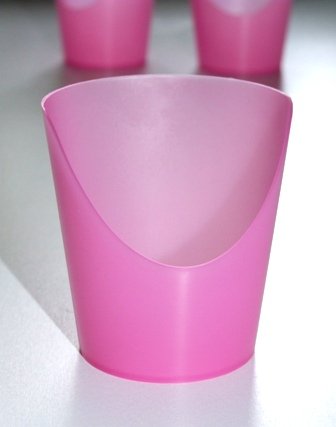
Begin to introduce open cup drinking around 6-7 months of age. Provided that your baby has good head control and can sit independently. Offer small, slow, controlled sips. Your child will have poor control and most of it will spill out, but with consistent practice, he will become better at it. A great training cup for your child is a nosey or flexi cup. They have a cut out so that you are able to tilt the cup higher without hitting your child’s nose. These are a staple in a feeding therapist bag of tricks. You can find them, HERE.
 |
| Picture credit: amazon.com |
Practice cup drinking in the tub, this is a great way to not worry about the mess! Cup drinking also helps to develop hand coordination and encourages the transition to solid food.
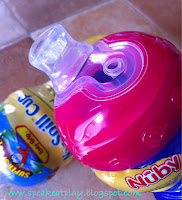 Around the same time, begin to replace the bottle with a sippy cup, although not a better solution, I like sippy cups because they come with spill proof options, making it more realistic that cup or straw drinking when you are on the go. Remember, as soon as your child is able to hold and drink from a cup or straw, spouted sippy cups should be discontinued. If your child is having a hard time transitioning to a sippy cup, I recommend the Nuby Super Spout Easy Gripper. These cups have a soft silicone spout that makes the transition from bottle easier as it resembles the nipples from a bottle. The spout is also designed to put little pressure on the gums and teeth. These cups have an easy grip which encourages hand to mouth coordination. The “TOUCH-FLO” feature releases the fluid with the pressure of your child’s sucking action, when your child stops sucking, the spout closes, eliminating leaks. This “valveless”, design makes it easier to clean. These Nuby cups are also very affordable, as it is one of the company’s missions to provide affordable quality products that are designed with child’s development in mind. You can purchase Nuby sippy cup, HERE.

A better solution is a straw drinking. Any speech-language pathologist can tell you how great drinking for a straw is for your child’s oral motor and feeding skills. Straw drinking can be taught as early at 9 months, I have seen babies learn before and some after, but a child should learn it on their own by 2 years of age. Don’t worry if your child can’t get the hang of it at first. It may take a while but with practice he will begin to understand the concept. Contact us if you need help with teaching your child to drink from a straw. Once your child can drink from a straw you can purchase cups that have straws that flip closed and not worry about spillage, like this great Munchkin cup, HERE. Take a look at these fun straws, HERE.
Here are some other tips on bottle weaning…
· Start early, the longer you wait the harder it will become. The older the child the harder the fight.
· Don’t always offer juice or water in a cup and the milk in a bottle, this will lead to your child refusing to drink milk from a cup.
· Be patient! Cup and straw drinking is a learned skill, your child will need lots of practice. Be prepared to get messy.
· If your child is old enough, let him help you select the cup, he will be more likely to use it.
· Offer your child the cup first and give the bottle only if he rejects it.
· Try to avoid getting your child used to falling asleep with a bottle, this will create a dependency to be soothed by the bottle and getting rid of it at this time will be a struggle. Instead offer the last milk of the day via a cup 30 minutes before bed time and offer other soothing sleep time routines like reading a book.
· Do not let your child crawl, walk or play with a bottle, this may create an attachment to it.
· Try different cups or sippy cups, some have straws, some handles other don’t, the options are unlimited. You will soon discover which one works for your child.
Good luck! And I hope the transition is an easy one. Remember to be patient and offer your child lots of cuddling and encouragement during the process. His teeth and mouth will thank you in the long run.
How did you get your child to stop using a bottle? Please comment below we love to have more ideas.